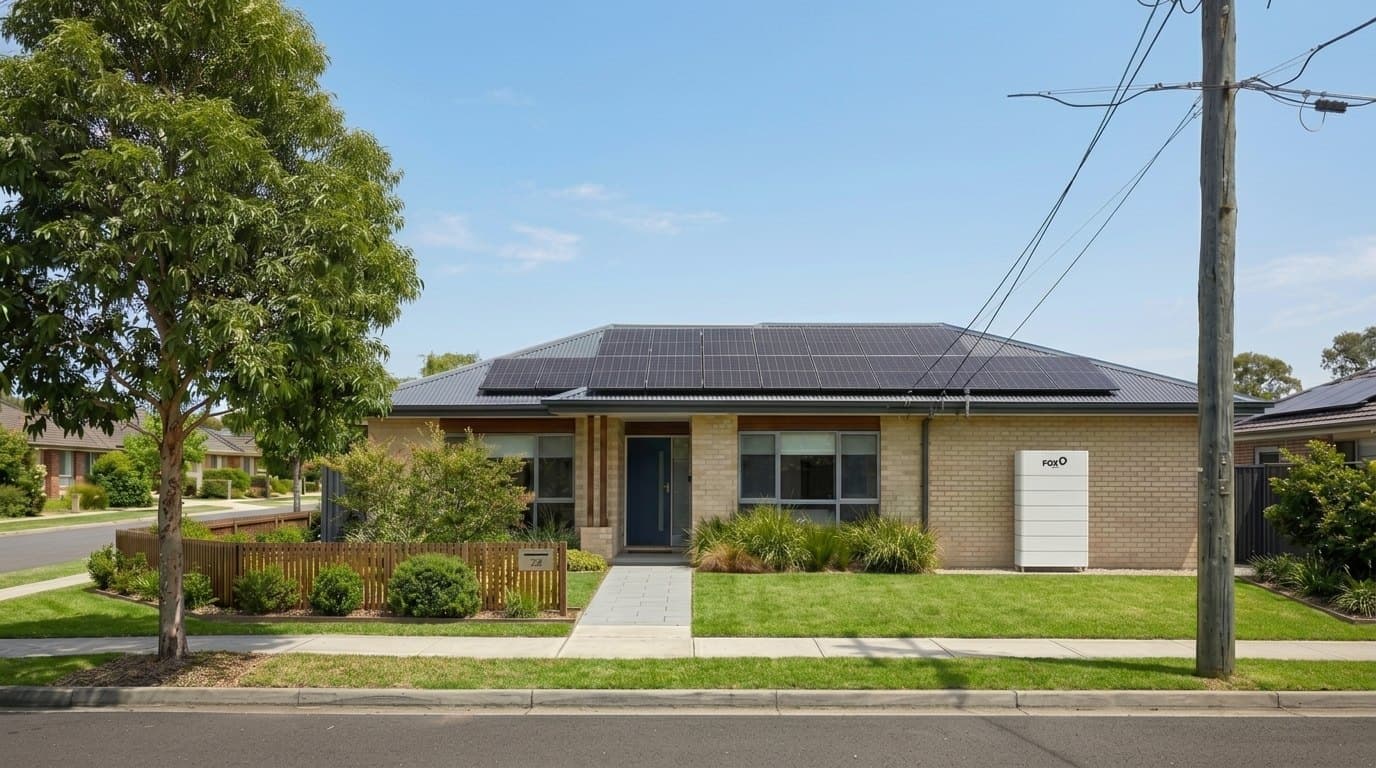
Solar and batteries for small business
Is solar worth it for a small business? How trading hours, demand charges, the 100 kW certificate line, the battery rebate and your lease change the answer.
Solar9 min read
By the Sunnn design team

The short version
- Most businesses use their power in daylight, so more of their solar gets used on site, which is where it is worth the most.
- Your trading hours decide the answer: open 8 to 5 is a strong fit for solar, open at night leans on a battery, and closed during the day often does not stack up.
- The battery rebate is not just for homes: the regulator says it supports households and small businesses, under the same rules.
- Check three things before you sign: whether your tariff has a demand charge, what your accountant says about tax, and whether your landlord agrees.
Why solar suits most businesses
A home is often empty at midday, so much of its solar goes to the grid for a small feed-in payment. Most businesses are the opposite: the lights, computers, fridges and air conditioning run while the sun is up.
That matters because of self-consumption, which just means using your solar power on site instead of sending it to the grid. Every kWh (kilowatt hour, the unit on your bill) you use yourself is a kWh you do not buy at your full business rate. Every kWh you export earns a feed-in tariff, which is usually far less. We explain why in Why solar feed-in tariffs keep falling.
For some businesses the export side is even weaker. The government's Solar Consumer Guide points out that some high-use businesses may not be able to get a plan that pays a feed-in tariff at all. For those businesses, its SunSPOT calculator suggests the biggest system that still lets at least 80% of the solar be used on site.
Your trading hours change everything
Solar makes power from early morning to late afternoon, strongest around the middle of the day. How much of that lines up with your opening hours is the single biggest question.
How much of your trading day the sun covers
| How you trade | Solar | Battery |
|---|---|---|
| Weekdays, roughly 8am to 5pm (offices, clinics, workshops, most shops) | Strong fit. Your busiest hours are the sunniest. | Modest. Mostly for weekends, late afternoons or demand charges. |
| Early starts, closed by mid-afternoon (cafes, bakeries that sell in the morning) | Good. The morning ramp-up is weaker, the middle of the day is strong. | Can help cover the early start from yesterday's surplus. |
| Evenings and nights (restaurants, bars, gyms) | Weak on its own. Much of it exports while you are closed. | Does the heavy lifting, so the maths needs a careful look. |
| Around the clock (cool rooms, refrigeration, farm pumps, small manufacturing) | Good. There is always a load on site to soak up the solar. | Useful for the steady overnight load if the solar is big enough to fill it. |
Weekends count too. An office closed on Saturday and Sunday will export most of two days of solar every week.
Certificates: the 100 kW line, and what changes on 1 October 2026
The upfront discount on solar comes from certificates called STCs (small-scale technology certificates). Your installer or retailer usually claims them and takes their value off the invoice.
The Clean Energy Regulator has used 100 kW of solar as the dividing line. Systems up to that size have created STCs. Systems over 100 kW have not been eligible for STCs. Instead they could be accredited as a power station under the large-scale scheme and create LGCs (large-scale generation certificates).
That line is moving. The regulations have been amended so that solar PV systems from 100 kW up to 1 MW installed from 1 October 2026 can create STCs. The regulator says applications will not open until mid to late November 2026, once its systems are in place. If you are planning a system over 100 kW, ask whoever quotes it which scheme it will fall under and how the timing affects the discount.
For most small businesses, a system under 100 kW is plenty. For larger sites, see our commercial solar page.
Does the battery rebate apply to businesses?
Yes. It is called the Cheaper Home Batteries Program, but the Clean Energy Regulator says it supports households and small businesses. A business battery follows the same rules as a home one:
- Between 5 and 100 kWh nominal capacity, with certificates on the first 50 kWh of usable capacity only.
- On the approved battery list, and technically able to join a virtual power plant.
- Installed with new or existing solar of no more than 100 kW.
- One battery per premises: for a grid-connected site, one per meter (NMI) or commercial sub-meter.
- Installed by a Solar Accreditation Australia accredited installer with a battery endorsement.
The discount also tapers as the battery gets bigger, which we break down in The 2026 home battery rebate, explained.
Demand charges, in plain English
Some business electricity plans include a demand charge. Most of your bill is based on how many kWh you use over the month. A demand charge is different: it is based on your single busiest half hour.
Ausgrid, which runs the poles and wires across much of Sydney, explains it like this. Demand is how hard you are pulling on the network at one moment, measured in kW. The charge is usually worked out from the highest 30-minute period in the peak window during the month, and that figure is multiplied by the number of days in the month. For small businesses, Ausgrid's peak window is 3pm to 9pm on working weekdays from June to August and November to March. Other networks and retailers set their own windows, so check yours.
An illustrative example: a cafe normally draws about 15 kW in the afternoon. One hot weekday at 4pm the oven, dishwasher, coffee machine and air conditioning all run at once and the meter records 30 kW for half an hour. On a demand plan, that one half hour can set the charge for the whole month.
A battery can shave that peak. It is set to discharge when the site's draw climbs, so the grid only sees part of the spike. The energy.gov.au business guide lists this as one of the ways a battery can earn its keep. Two cautions:
- The battery needs enough power (kW), not just storage (kWh), and it has to be charged and ready at the right moment. Miss one busy half hour and that sets the charge.
- The cheapest fix is often free. Ausgrid's first suggestion is to take turns with big appliances rather than running them all at once.
If your bill has no demand line charged in kW, this section may not apply to you.
Tax: ask your accountant
We are not tax advisers, so this is only what the ATO publishes. The $20,000 instant asset write-off is now permanent from 1 July 2026 for small businesses with an aggregated turnover under $10 million. It applies to eligible depreciating assets costing less than $20,000, per asset, first used or installed ready for use in that income year. Assets costing $20,000 or more can go into the small business depreciation pool, at 15% in the first year and 30% a year after that.
Whether your system qualifies, and how, is a question for your accountant. Take your quote to them before you sign.
Renting your premises
If you lease your shop, office or shed, you probably do not own the roof, so you need the owner's permission. In a multi-occupancy strata property you also need the body corporate. The government's guide suggests writing the deal into the lease, with legal advice on both sides, covering who pays, who owns the system, who maintains it, and what happens when the lease ends.
A battery raises one extra point. To keep its certificates, the regulator says a rebated battery should stay at the property for its warranty period or until the end of 2030, whichever is later. If you move it to another premises, it is no longer eligible, so plan on leaving it behind.
When it does not stack up
Solar is not right for every business:
- Closed during the day. A bar that opens at 5pm exports most of its solar. A battery can shift it, but on a small roof it may not be worth the cost.
- Very small usage. A small bill means a small saving, while install costs do not shrink much.
- A short lease. With only a year or two left and no deal with the landlord, you may leave before it earns back its cost.
- The roof. Heavy shade, a roof due for replacement, or a strata body that will not agree can end the conversation.
- No usable data. Without interval meter data it is guesswork. You can ask your distributor for it in a format called NEM12.
A good quote should tell you when not to buy.
Next step
The savings calculator gives a quick first look. For a proper design, check your eligibility: we look at when your business actually uses power, then design and quote solar and battery to suit, with the certificates itemised on the quote and installation arranged through accredited installers. If your vehicles are part of the picture, see Charging an EV with solar and a battery. Savings figures are modelled estimates, not guarantees.
Common questions
Can a small business get the Cheaper Home Batteries rebate?
Yes. Despite the name, the Clean Energy Regulator says the program supports households and small businesses. The battery must be 5 to 100 kWh nominal, on the approved list, able to join a virtual power plant, installed with solar of no more than 100 kW, and fitted by an accredited installer. One battery per meter or commercial sub-meter.
What is the difference between STCs and LGCs for business solar?
STCs are small-scale certificates that come off your invoice as an upfront discount. Systems over 100 kW have instead been accredited as power stations that create LGCs, with no upfront STC discount. From 1 October 2026, solar systems up to 1 MW can create STCs, with applications opening from mid to late November 2026.
Can a battery reduce my business demand charge?
It can, if your plan has one. A demand charge is based on your busiest half hour in a peak window, so a battery that discharges during those spikes lowers the peak the grid sees. It needs enough power in kW and must be charged at the right time. Staggering big appliances is often the cheapest first step.
Can I claim solar under the instant asset write-off?
Possibly. From 1 July 2026 the ATO's $20,000 instant asset write-off is permanent for small businesses with turnover under $10 million, for eligible assets costing under $20,000 each. Whether your system qualifies, and how, is a question for your accountant.
Sources
- energy.gov.au: Solar for businesses
- energy.gov.au: Solar for rentals and multi-occupancy properties
- Clean Energy Regulator: Defining small-scale and large-scale solar systems
- Clean Energy Regulator: Solar batteries
- Ausgrid: An introduction to demand pricing
- ATO: $20,000 instant asset write-off
General information only, not financial advice. Rebates and market rules change; check the sources above for the current position. Any savings figures are modelled estimates, not guarantees. See our disclosures.